Basement Epoxy Flooring Guide
Free project tools
Use this guide with planning tools
Square Footage Calculator
Measure your room, calculate material needs, and get a ballpark cost estimate in seconds.
Calculate Size →Coating Type Selector Quiz
Answer 5 quick questions and get a personalized recommendation for the best epoxy coating for your space.
Find Your Coating →Epoxy & Garage Floor Cost Calculator
Use garage presets or exact dimensions, compare coating systems and preparation, then share a contractor-ready cost plan.
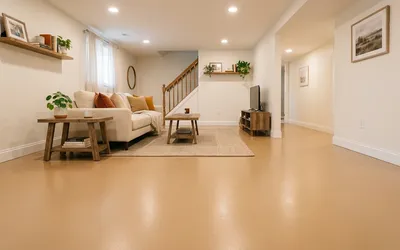
Calculate Cost →Basement floors are often the most overlooked surfaces in a home, cold, gray concrete that collects dust and feels unfinished. Epoxy coating transforms that bare slab into a clean, durable, and attractive floor that makes your basement feel like a genuine living space. But basements come with unique challenges, especially moisture. This guide covers everything you need to know before coating your basement floor with epoxy.
Why Epoxy Works Well for Basements
Epoxy is one of the best coating options for basement floors for several reasons:
- Moisture resistance: Once cured, epoxy creates a seamless, non-porous barrier that resists water on the surface (spills, minor seepage, humidity).
- Brightness: Light-colored epoxy floors dramatically brighten basement spaces, which often have limited natural light.
- Warmth underfoot: While not an insulator, epoxy over concrete feels warmer and less harsh than bare concrete, especially with area rugs.
- Easy cleaning: The seamless surface doesn't trap dust, allergens, or moisture the way carpet or poorly sealed concrete does.
- Versatile aesthetics: From solid colors to metallic finishes, epoxy lets you match the floor to your basement's purpose, whether it's a home gym, office, entertainment room, or playroom.
The Moisture Problem (and How to Solve It)
Moisture is the single biggest concern with basement epoxy, and it's the reason so many DIY basement epoxy projects fail. Concrete is porous, and basement slabs sit directly on soil. Even if your basement looks dry, moisture vapor can be migrating through the slab from below.
If epoxy is applied over a slab with excessive moisture vapor transmission (MVT), the coating will eventually bubble, blister, or delaminate. This can happen weeks or months after installation.
How contractors address moisture:
- Calcium chloride test (ASTM F1869): This standard test measures the rate of moisture vapor emission from the slab. Results above 3 lbs per 1,000 sq ft per 24 hours indicate a moisture problem that needs mitigation.
- Relative humidity test (ASTM F2170): Probes are placed in drilled holes to measure internal slab humidity. Results above 75% RH typically require a moisture mitigation primer.
- Moisture-mitigating primers: If moisture levels are elevated but not extreme, specialized epoxy primers can create a vapor barrier between the slab and the coating.
- Drainage solutions: If active water intrusion is present (standing water, wet walls), that must be resolved before any coating is applied. Epoxy can't fix a waterproofing problem.
Never skip moisture testing on a basement floor. Even if the surface feels bone-dry, subsurface moisture can be present. A qualified contractor will always test before coating, and this step alone can save you from a costly failure.
Choosing the Right Basement Epoxy System
The best coating system for your basement depends on how you plan to use the space:
| Basement Use | Recommended System | Approx. Cost |
|---|---|---|
| Storage / Utility | Solid-color epoxy (1–2 coats) | $3–$5/sq ft |
| Home Gym / Workshop | Flake epoxy with clear topcoat | $5–$7/sq ft |
| Family Room / Playroom | Flake or solid with anti-slip topcoat | $5–$8/sq ft |
| Finished Living Space | Metallic epoxy with clear topcoat | $7–$12/sq ft |
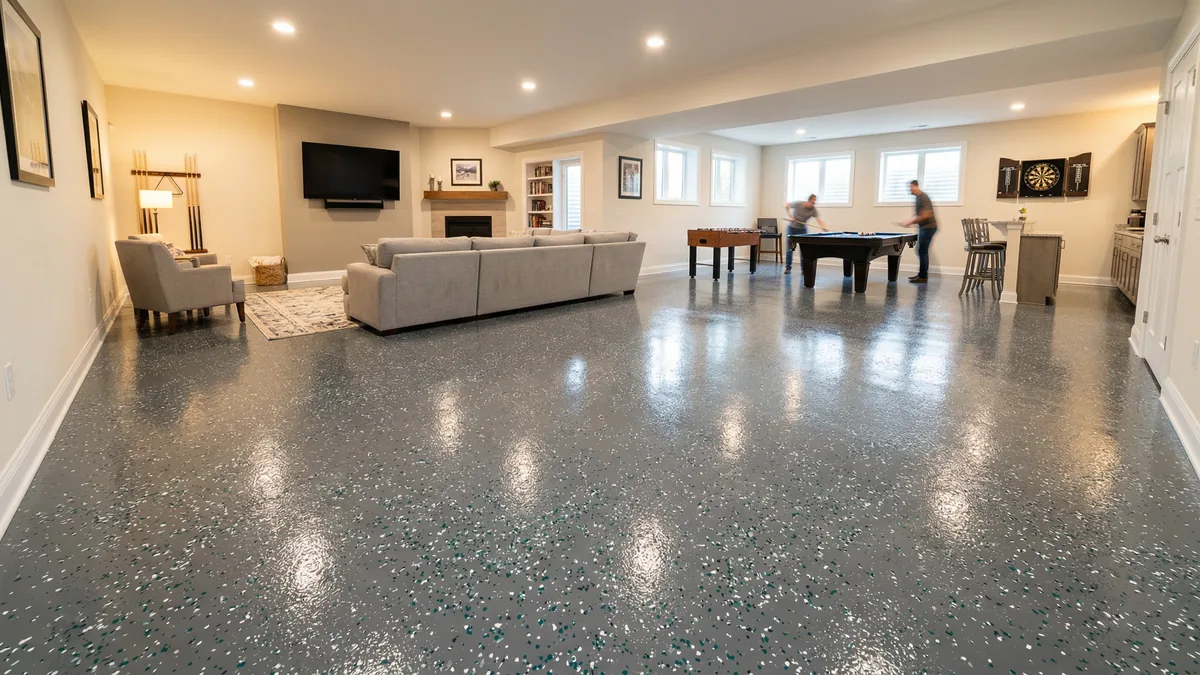
For most basements, a flake system with a clear polyurethane or polyaspartic topcoat offers the best balance of appearance, durability, and value. The flakes hide minor imperfections in the concrete and provide subtle texture that helps with slip resistance, important in basements that may see occasional dampness.
Ready to Get Started?
Get free, no-obligation quotes from local epoxy flooring contractors in your area.
Get Free Quotes →The Installation Process
Here's what to expect when a contractor coats your basement floor:
Day 1: Preparation The contractor will clear the space, grind or shot-blast the concrete surface, fill cracks and divots, and perform moisture testing. This prep phase is the most labor-intensive and most critical part of the project.
Day 2: Primer and Base Coat A moisture-mitigating primer is applied first (if needed), followed by the epoxy base coat. If using a flake system, the flakes are broadcast into the wet epoxy.
Day 3: Topcoat After the base coat cures, the contractor applies a clear topcoat (polyurethane or polyaspartic) for UV protection, scratch resistance, and a finished sheen.
Cure Time: You can typically walk on the floor in 24 hours and move furniture back in after 48–72 hours. Full chemical cure takes about 7 days.
Common Basement Epoxy Mistakes to Avoid
- Skipping moisture testing: This is the most common mistake and the most costly. Always test, even if the basement seems dry.
- Not addressing cracks properly: Cracks should be routed and filled with flexible filler, not just coated over. Coated-over cracks will reappear.
- Poor ventilation during application: Epoxy fumes need ventilation. Make sure your contractor plans for adequate airflow during application and curing.
- Choosing the wrong system for the use case: A thin single-coat system won't hold up in a home gym with dropped weights. Match the coating system to how you'll actually use the space.
- DIY on a basement with unknown moisture: Basements are the riskiest environment for DIY epoxy because moisture problems are common and hard to detect without proper testing equipment.
Is Basement Epoxy Worth It?
Absolutely, for most homeowners. A finished basement floor makes the space more usable, cleaner, and more inviting. Compared to other basement flooring options like carpet (which can mold), vinyl plank (which can warp with moisture), or tile (which is expensive and cold), epoxy offers a compelling combination of durability, moisture resistance, and visual appeal at a competitive price.
For a typical 600 sq ft basement, expect to pay between $2,500 and $5,000 for a professional flake or solid-color installation. Metallic finishes for a finished living space will run higher. The investment adds real value to your usable living space.
Ready to transform your basement? Get free quotes from basement epoxy contractors in your area, or learn more about basement epoxy flooring services.
Ready to Get Started?
Get free, no-obligation quotes from local epoxy flooring contractors in your area.
Get Free QuotesTexas contractor directory
Find epoxy contractors by local market
Compare local epoxy flooring companies in the strongest Texas markets before requesting a quote.
Sources and editorial method
This guide is educational content prepared from coating-system specifications, common installation practices, publicly available market information, and the directory's contractor data. Costs and service life are planning ranges, not guarantees. Confirm product specifications, slab conditions, code requirements, and written warranty terms with the contractor and coating manufacturer.
Review our directory methodology, content disclaimer, and contractor hiring checklist.
Find Epoxy Contractors Team
Our editorial team explains epoxy flooring options, cost factors, maintenance, and contractor-selection questions. Guides provide general planning information and are reviewed for consistency with our published methodology and directory disclosures.